
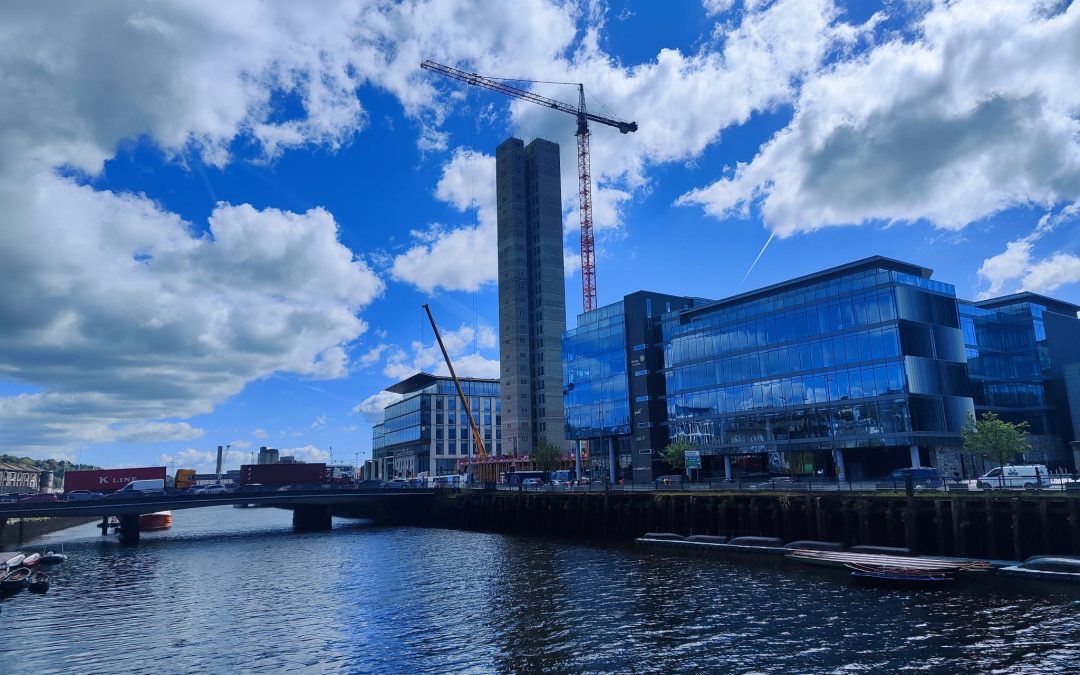
One need only look at Cork’s skyline to see the exciting progress on the impressive 25-storey Railyard in Cork. It’s certainly a moment of pride for Cork City locals, and it’s a landmark in both senses of the word. At BCE Consulting Engineers, we see and hear this impressive building going up right from our doorstep here at the Cork Marina.
Cork will reclaim the title of having the tallest residential building in Ireland upon completion of this tower. That title was originally held by The Elysian (71m) in Cork from 2008 to 2018. It was surpassed by the Capital Dock (79m) and the College Square (82.1m) developments in Dublin, but the title is once again coming home to Cork and only about 200m away from the Elysian on Albert Quay. The Railyard will stand at over 85m tall when completed in late 2027.
What Is the Railyard Development?
The Railyard Apartment Scheme is a development planned collaboratively between Cork City Council, Clúid Housing, and JCD Group. The residential building will become the tallest building in Ireland when completed in 2027, standing at approximately 85.5m consisting of 25 storeys and a total of 217 homes. The development is taking place in Albert Quay, on the former site of The Sextant pub.
The design features three cores, the first of which was the 25-storey main core. It will step down to a 13-storey and a 9-storey block. The development will also incorporate two renovated structures, Carey House and the former railway terminus.
For fellow Corkonians who remember The Elysian going up, the main contractor for the Railyard is none other than Cork local PJ Hegarty. The Railyard’s designers are Henry J Lyons architects and civil and structural engineer Richard Coleman.
The Engineering Challenge of Building Tall in Cork
Erecting a high-rise building is quite a tall feat, but it’s especially challenging in Cork due to our city’s unique ground conditions. The land on either side of the River Lee is reclaimed marshland. This is not ordinary bedrock ideal for tall skyscrapers, but rather soft alluvial soils that require deep foundations and considerable geotechnical expertise. Cork’s name itself is reflective of the soil conditions, with Corcaigh being derived from corcach, “marsh.” Historically, this area was known as Corcach Mór Mumhan, “The Great Marsh of Munster”.
Moreover, tall buildings are affected more by wind. The Railyard in Cork will be around 85.5m tall when complete, so wind loading becomes a serious structural force. Project engineers had to account for dynamic wind loading, using advanced models that account for oscillation and sway.
Another big challenge which has already been completed was pouring the enormous concrete lift and stair core. Specialist contractor Slipform UK used a vertical slipform method, whereby concrete was poured continuously as workers placed reinforcing steel and formwork while being raised up on a work platform. The concrete at the bottom has to set, so there is a limit to how fast they can work. Nevertheless, it was remarkably fast as nearly two and a half floors were poured per day with teams working 24/7 over 10 days. Over 1,700 cubic metres of concrete were poured over 225 tonnes of reinforcing steel in total.
Lastly, as the tallest Cork City development, the Railyard requires complex structural engineering to ensure that it’s sound and stable. Building a skyscraper in Ireland is not an everyday activity, but it does require many more design and engineering considerations than most other buildings. The building’s core must be able to resist static and dynamic vertical loading, but it must also resist horizontal forces such as wind. Because the Railyard is quite slender and its design “steps down” to the lower blocks, the structural design is further complicated.
The Protected Structures Challenge
As though it weren’t already enough of an engineering challenge to erect a high-rise here in Cork, the development is also incorporating the renovation of Carey House and the former railway terminus building. These are listed buildings and protected structures, and they have several conservation requirements that must be met. These requirements include the use of specific materials and finishes to maintain the historical character and aesthetics, so even with required planning permissions, one can’t simply do as they please.
What makes this challenging for the developers is that these specific conservation works are taking place as part of the development of a high-rise residential building. They’re having to manage the conservation of old historic buildings whilst simultaneously planning and engineering a modern high-rise using modern techniques. It’s exciting to see how it will turn out, but as engineers with expertise in conservation and protected structures, we know just how challenging this must be for the developers.
Cork’s Skyline: A City on the Rise
Cork City and the docklands are evidence of a city on the rise. As of April 2026, the Horgan’s Quay apartment development is nearly complete, the former site of the Marquee has brought 330 new homes, Carin Homes on Kinsale Road delivered over 600 new apartments, and there are even talks of a massive 34-storey tower on Custom House Quay at the Port of Cork site.
The Railyard is going to be a capstone on Cork’s skyline and will certainly cement the transformation that Cork and the docklands have been going through. Cork used to build low, now it’s aiming high and showing remarkable change. At BCE Consulting Engineers, we are excited for this transformation and understand the engineering challenges that come with these new developments.
Local Pride from Local Engineers
BCE Consulting’s engineers are eagerly anticipating the completion of the Railyard in Cork, not just because it shows how incredible civil engineering can be, but also because it is a milestone event for Cork City.
Whether you’re planning a development in Cork, big or small, BCE Consulting offers professional engineering services.

Recent Comments